 extensively, particularly on the flying butresses that
rise up on each side if the tower. The core of the pyramid was composed
of polystyrene and plastic patterns cast in clear polyester, backed
with acrylic sheets cut to size. Internal lighting for the pyramid
me from florescent tubes built into the model,shining through
thousands of holes scraped at random in the painted plastic
panels.Additional lighting on the towers atop the structure were
axial lights; �Axial lights were developed primarily for illuminating
liquid crystal display watches� (Cinefex, p.17). An oversized
section of
extensively, particularly on the flying butresses that
rise up on each side if the tower. The core of the pyramid was composed
of polystyrene and plastic patterns cast in clear polyester, backed
with acrylic sheets cut to size. Internal lighting for the pyramid
me from florescent tubes built into the model,shining through
thousands of holes scraped at random in the painted plastic
panels.Additional lighting on the towers atop the structure were
axial lights; �Axial lights were developed primarily for illuminating
liquid crystal display watches� (Cinefex, p.17). An oversized
section of
 the pyramid was built for the close-ups needed for the film�s opening fly-by. The photograph was double exposed to show the computer-controlled camera movement, in this case an upward tilt. The model was four feet high, five feet wide, and included several working lifts, which included three inch tall cars. Since the fly-bys required the camera to�see� into specific offices, two tiny rooms were built and matched to the full-scale sets. These miniature rooms included one-quarter-inch tall figures and tiny ceiling fans. |
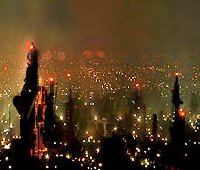 Unlike the pyramid, the �Hades� landscape had to be lit
using fiber optics. �Holes were drilled in the Plexiglas base of the
model and the fiber optics were threaded up from beneath the table
and positioned behind the etched-metal grids, with just the tip of the
fiber to be the camera� (Ibid). Initially planned to be between
Unlike the pyramid, the �Hades� landscape had to be lit
using fiber optics. �Holes were drilled in the Plexiglas base of the
model and the fiber optics were threaded up from beneath the table
and positioned behind the etched-metal grids, with just the tip of the
fiber to be the camera� (Ibid). Initially planned to be between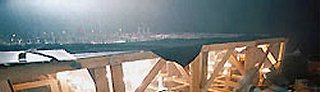 �fifteen or eighteen feet wide�(Cinefex, p. 17), the Hades
landscape was set up as a forced perspective model, but Ridley
Scott and Douglas Trumbull had other ideas, �Ridley and Doug didn�t
want to be tied to a single point of view. So we then changed it
[Hades]over to a diminishing perspective - the difference being
that the forced perspective model could be shot from only one point of
view,whereas the diminishing perspective one would be suitable from
a general camera angle� (Cinefex,p. 18)
�fifteen or eighteen feet wide�(Cinefex, p. 17), the Hades
landscape was set up as a forced perspective model, but Ridley
Scott and Douglas Trumbull had other ideas, �Ridley and Doug didn�t
want to be tied to a single point of view. So we then changed it
[Hades]over to a diminishing perspective - the difference being
that the forced perspective model could be shot from only one point of
view,whereas the diminishing perspective one would be suitable from
a general camera angle� (Cinefex,p. 18) 
The turret-shaped police headquarters building and its ancillary buildings were influenced by the science fiction film Metropolis (1926, Fritz Lang). |
|
|