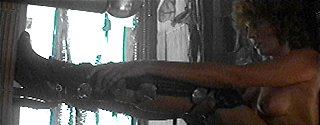
 protection from the elements it also places her body as a
spectacle to be consumed by the male gaze. The plastic raincoat, like
the make-up of Pris, also serves to heighten the artificiality of
Zhora. The death of Zhora is also a take on the ‘dance of the seven
veils’ but instead of revealing herself from under the veils she
has to constantly break through the windows of shop fronts which
have in them mannequins adorned with very little, making a show of
protection from the elements it also places her body as a
spectacle to be consumed by the male gaze. The plastic raincoat, like
the make-up of Pris, also serves to heighten the artificiality of
Zhora. The death of Zhora is also a take on the ‘dance of the seven
veils’ but instead of revealing herself from under the veils she
has to constantly break through the windows of shop fronts which
have in them mannequins adorned with very little, making a show of 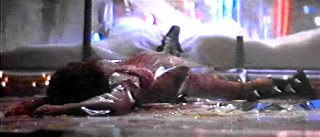 their bodies and placing them as product. The dead body of Zhora lies on the ground surrounded by mannequins that have been knocked over in her failed escape, and the shards of broken glass which signify the shattered walls of a glass menagerie also resemble, in their transparency, the transparent plastic raincoat.
|
 On the other hand, the costuming of Rachael changes throughout the course
of the film. Her clothing tout de suite locates the character in a
kinship to history - it dislocates her from the ‘modern’ and relocates
her in the ‘classic’. Her cool exterior, the sound of her heels on
the floor, the thick layers of smoke that nearly always seem to
obscure her features together with the elevated level at which she
lives all provide her a weight of social class, of authenticity.
On the other hand, the costuming of Rachael changes throughout the course
of the film. Her clothing tout de suite locates the character in a
kinship to history - it dislocates her from the ‘modern’ and relocates
her in the ‘classic’. Her cool exterior, the sound of her heels on
the floor, the thick layers of smoke that nearly always seem to
obscure her features together with the elevated level at which she
lives all provide her a weight of social class, of authenticity.
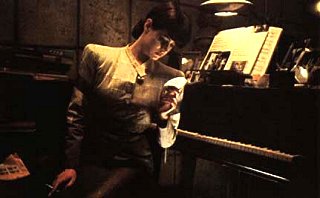 Later, her costume enables/reflects changes in the character.
Her clothing becomes less rigid and more pedestrian, which also
mirrors the change in social status that the character has gone through
- she is now classed as an illegal alien. This transformation is
completed by the symbolic embracing of her sexuality in the form
of letting down her hair.
Later, her costume enables/reflects changes in the character.
Her clothing becomes less rigid and more pedestrian, which also
mirrors the change in social status that the character has gone through
- she is now classed as an illegal alien. This transformation is
completed by the symbolic embracing of her sexuality in the form
of letting down her hair.
|
 In contrast to all this, Batty’s nakedness at the climax of the film
seems to almost personify him as the ideal male body. Whereas the
exposure of Zhora’s body takes place in an exploitative context, the
exposure of Batty’s body - wearing nothing but a pair of
lycra shorts and footwear - symbolises male prowess.
In contrast to all this, Batty’s nakedness at the climax of the film
seems to almost personify him as the ideal male body. Whereas the
exposure of Zhora’s body takes place in an exploitative context, the
exposure of Batty’s body - wearing nothing but a pair of
lycra shorts and footwear - symbolises male prowess.
 Except for some high-speed 35mm photography of explosions, all the
special effects work was done in 65mm film (the negative is 65mm,
while the print is 70mm). Trumbull prefers working in 65mm to 35mm
or 'Vistavision' and he recommended
Except for some high-speed 35mm photography of explosions, all the
special effects work was done in 65mm film (the negative is 65mm,
while the print is 70mm). Trumbull prefers working in 65mm to 35mm
or 'Vistavision' and he recommended |
|